Holidays
Jewish holidays in Kabotsville
Rabbi Kabot explains each holiday and the beautiful meaning behind it, and Mrs. Kabot leads the traditions at home and in the kitchen.
Holiday videos
Watch the holiday stories here, one after another in this series. Challah is for every week. Hanukkah is next.
Hanukkah Lights
Rosh Hashanah
The Great Sukkah Rescue
Purim
Passover
Pick a holiday
Tap a holiday to watch the video, read the picture book, or take the quiz.
Quizzes, stickers & books
Take a quiz or read the picture book for any holiday below.
-
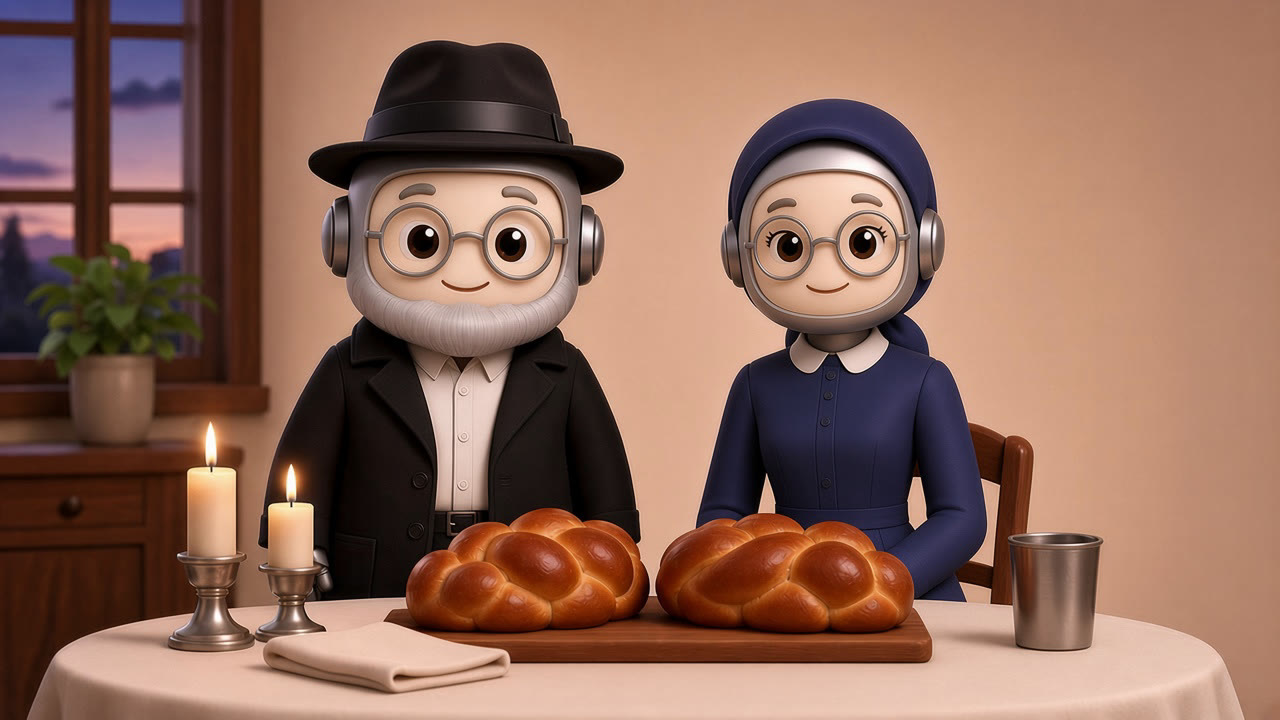
Shabbat
Kabotsville Lesson 3Mrs. Kabot's Kitchen: The Great Challah Comeback
Learns: How to bake challah step by step, and separating challah
Ages 3 to 8
Story idea by a Botsville family
More about this lesson: Mrs. Kabot's Kitchen: The Great Challah Comeback
How to bake challah step by step, separating challah, and what Shabbat is.
What kids learn
- How to bake challah step by step, and separating challah
- What Shabbat is: a weekly day of rest from Friday before sundown until Saturday night
Tonight is Shabbat, and the whole neighborhood is coming for dinner! But when Noodle, the friendly neighborhood puppy, gobbles up the challah cooling by the window, Mrs. Kabot calmly shows Pebbit, Stack, Widgely and Trilla how to bake it again, step by step: knead the dough, let it rise, separate challah with a blessing, braid three ropes and brush on egg. Rabbi Kabot stops by to explain separating challah: long ago a piece of the dough was a gift for the kohanim, and it reminds us that what we have isn't only for us. Together they save Shabbat dinner, and Rabbi and Mrs. Kabot explain what Shabbat is: a weekly day of rest from Friday just before sundown until the stars come out on Saturday night, with Shabbat candles, Kiddush, two challahs that remind us of the double portion of manna, time for family and friends, and Havdalah. Noodle is fine and nobody is in trouble: he gets his own dog treat and a bowl of water. Shabbat Shalom!
Try it at home: Next time you bake challah, ask a grown-up to help! Keep food covered and up high, and remember that only grown-ups use the oven. Bread and raw dough aren't food for dogs.
-
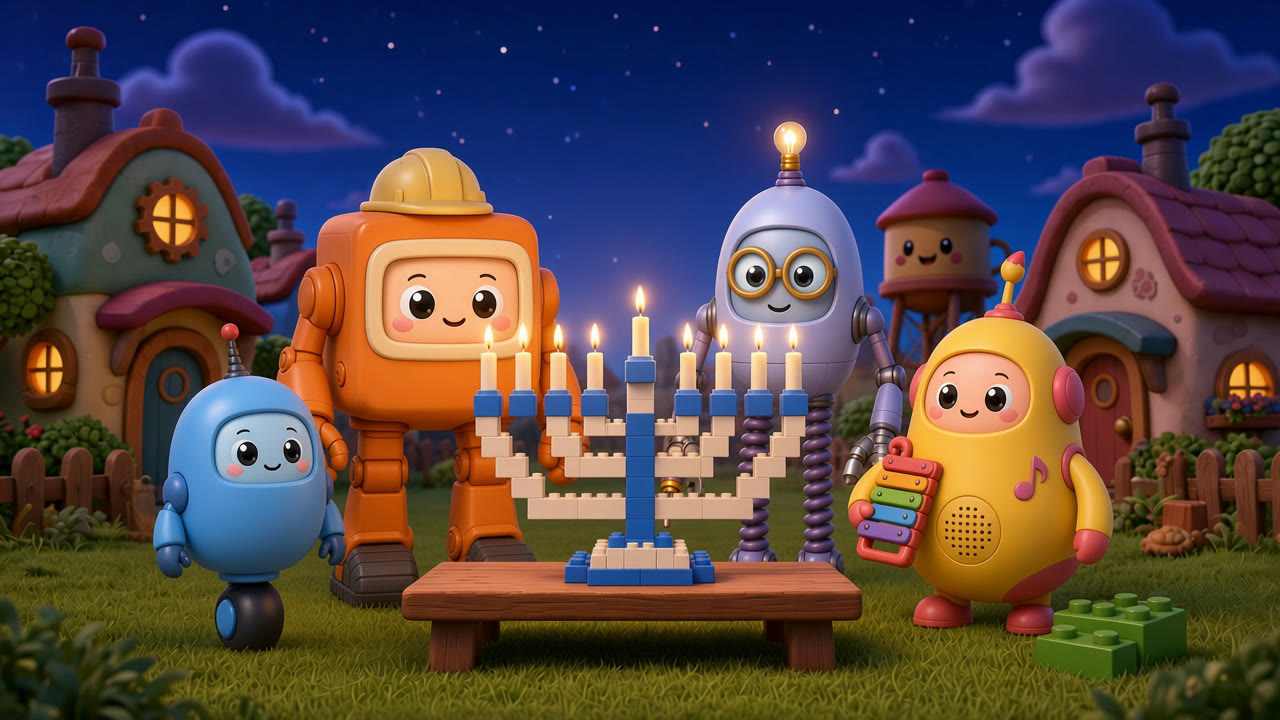
Hanukkah
Kabotsville Lesson 1Hanukkah Lights
Learns: Why Hanukkah has eight nights: the story of the little jar of oil
Ages 3 to 8
More about this lesson: Hanukkah Lights
Learning about Hanukkah, the Festival of Lights, and counting eight candles.
What kids learn
- Why Hanukkah has eight nights: the story of the little jar of oil
- The shamash helper candle, and counting the candles
The bots build a blue-and-white brick menorah, and Rabbi Kabot, a kind and wise bot, comes to visit and explains Hanukkah: long ago the brave Maccabees got back the holy Temple in Jerusalem and made it special again, and one little jar of oil kept shining for eight days. The helper candle called the shamash lights the others (and reminds us we can be helpers too), one more candle is added each night, and the menorah goes in a window so everyone can see the light. They count all eight candles, spin a dreidel, talk about latkes and jelly doughnuts cooked in oil, and sing along to a Hanukkah tune with words on the screen.
Try it at home: Count the candles with a grown-up! Remember, only grown-ups light real candles.
-

Rosh Hashanah
Kabotsville Lesson 6Kabot Holidays: Rosh Hashanah
Learns: Rosh Hashanah: the Jewish New Year, the world's birthday, apples and honey, and Shanah tovah
Ages 3 to 8
More about this lesson: Kabot Holidays: Rosh Hashanah
Rosh Hashanah is the Jewish New Year and the birthday of the world, with apples and honey, the shofar, and a fresh start at tashlich.
What kids learn
- Rosh Hashanah: the Jewish New Year, the world's birthday, apples and honey, and Shanah tovah
- The shofar's wake-up call and tashlich: a fresh start by the water
The whole family gathers at a cozy cabin by Niagara Falls for a double birthday: Rosh Hashanah, the birthday of the world, and Baby Botcohen's first birthday. Before sundown they hunt for seven special foods, bake a round challah, open Daddy's toy-brick gift, welcome the Steinbots, and get a sweet hello from Grandpa in space. At sunset they dip apples in honey and say Shanah tovah. The next morning they hear the shofar, and in the afternoon they do tashlich by the water. Shanah tovah!
Try it at home: Dip apple slices in honey and say Shanah tovah. Talk about one fresh start you want this year, and listen for a shofar (or a friendly toot!) together.
-
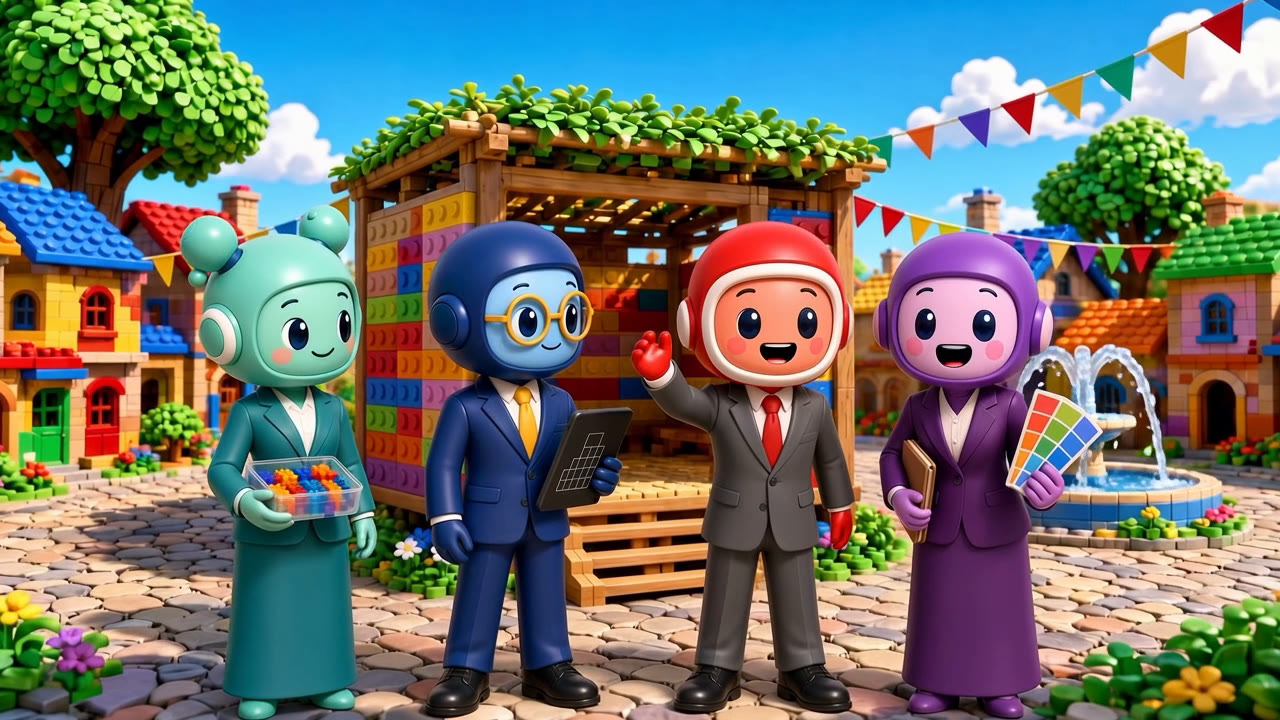
Sukkot
Kabotsville Lesson 2The Great Sukkah Rescue
Learns: How to build a sukkah the right way: sturdy walls, the right height and schach on top
Ages 3 to 8
More about this lesson: The Great Sukkah Rescue
Learning how to build a sukkah the right way for Sukkot, and about the lulav and etrog.
What kids learn
- How to build a sukkah the right way: sturdy walls, the right height and schach on top
- The four kinds: the lulav with myrtle and willow, and the etrog
Sukkot starts tomorrow when a gust of wind tips over the big city sukkah in the town square (nobody was inside, and everyone is safe). The Builder Team cleans up, finds out the walls weren't braced or tied tight, and Rabbi Kabot, a kind and wise bot, arrives to teach them the rules as they rebuild it the right way: at least three walls sturdy enough to stand in a normal wind (even toy bricks work), not too short and not too tall, and a roof covering called schach made of cut plants like branches and bamboo, with more shade than sun, room to see the stars, and no tree or roof above it. Remixa decorates it, the crew shares their first holiday meal inside, Rabbi Kabot shares that the sukkah reminds us of the clouds of glory that protected the Israelites in the desert, and the next morning he leads the four kinds: the lulav (palm branch) bound with myrtle and willow, held together with the etrog (citron), with a blessing, then waved in all six directions. Chag Sameach!
Try it at home: Next Sukkot, visit a sukkah with a grown-up and check: how many walls does it have, and can you see the stars through the schach?
-

Purim
Kabotsville Lesson 4Kabot Holidays: Purim
Learns: The Purim story: brave Queen Esther, Mordechai and mean Haman
Ages 3 to 8
More about this lesson: Kabot Holidays: Purim
The Purim story of brave Queen Esther, why we dress up, and the four Purim mitzvahs.
What kids learn
- The Purim story: brave Queen Esther, Mordechai and mean Haman
- The four Purim mitzvahs: the Megillah, mishloach manot, gifts to the poor and a festive meal
The Purim parade is today, and the Kabot children can't decide what to wear! So Rabbi and Mrs. Kabot and the Botcohens tell the Purim story: in Shushan, brave Queen Esther and her cousin Mordechai stood up to mean Haman (shake the groggers!), and sadness turned into joy. Hashem's name isn't written in the Megillah, but Hashem was helping all along, hidden behind the scenes, which is one beautiful reason we dress up. Grandpa calls from his rocket in space, the Botcohens bring toy-brick groggers and a Purim basket, the Steinbots fly in from Botsberg, and everyone learns the four Purim mitzvahs before heading to the Kabotsville Purim parade.
Try it at home: Make a Purim basket with two yummy treats to give to a friend, and pick a costume that is brave and kind like Queen Esther!
-
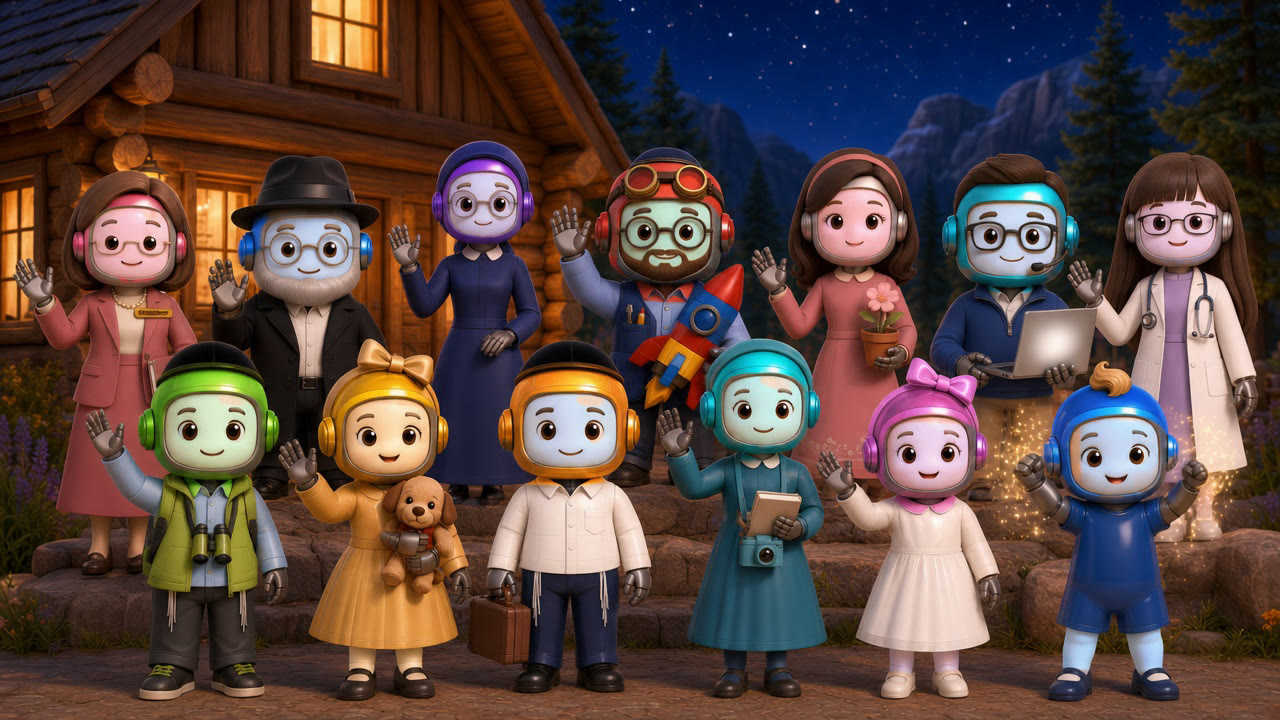
Passover
Kabotsville Lesson 5Kabot Holidays: Passover
Learns: The Passover story: Moses, Pharaoh and leaving Egypt, from slavery to freedom
Ages 3 to 8
More about this lesson: Kabot Holidays: Passover
The Passover story of leaving Egypt, the Seder plate, the Four Questions and why we eat matzah.
What kids learn
- The Passover story: Moses, Pharaoh and leaving Egypt, from slavery to freedom
- The Seder: the Seder plate, the Four Questions, matzah and the four cups
Passover starts tonight, and the whole family flies in the flying car, with Baby Steinbot as co-pilot, to have their Seder together at Yellowstone, arriving long before the holiday begins. Before Passover starts, Grandpa calls from outer space on Nana's tablet. They see a bison and Old Faithful, and at sunset Passover begins. Rabbi Kabot explains that Seder means order and the Haggadah tells the story. Mrs. Kabot shows the Seder plate: bitter maror, sweet charoset, and a vegetable dipped in salt water. A Kabot child asks the Four Questions, and everyone tells the story together: Pharaoh, Moses saying "Let my people go!", the ten plagues, matzah that had no time to rise, and Hashem splitting the sea so the Jewish people walked across to freedom. They drink four cups of grape juice, lean on pillows, and remember to tell the story to the next generation. Next year in Jerusalem! Happy Passover!
Try it at home: Practice the Four Questions with a grown-up, and look for the maror, the charoset and the salt water on a Seder plate.
Many Botsville stories started as ideas from real kids and families! Mrs. Kabot's Kitchen: The Great Challah Comeback started as a story idea from a Botsville family.
More from Botsville USA
Everyday Botsville stories — not holiday chapters.
Parents: Want a video, holiday, or something new for your kids? Email us!
✉️ Email us: feedback@botvilleusa.com 🛠 Botsville Builders can work with you